We Use CookiesWe use cookies to enhance the security, performance, functionality and for analytical and promotional activities. By continuing to browse this site you are agreeing to our privacy policy

10 Best Grass Fertilizers 2026 in the United States
How do we rank products for you?

Our technology thoroughly searches through the online shopping world, reviewing hundreds of sites. We then process and analyze this information, updating in real-time to bring you the latest top-rated products. This way, you always get the best and most current options available.

headphones-stars

Our Top Picks

#1

Winner

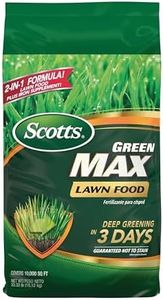
Scotts Green Max Lawn Food, 33.33 lbs.

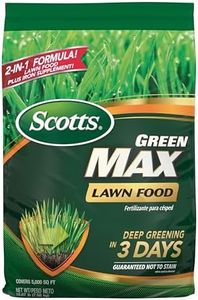
Scotts Green Max Lawn Food is a granular fertilizer designed to cover up to 10,000 sq. ft., making it suitable for medium to large lawns. Its NPK ratio is 27-0-2, providing a high amount of nitrogen to encourage green, leafy growth but very little phosphorus and potassium. This focus makes it ideal primarily for promoting lush, green grass rather than root development or flower growth. The fertilizer also contains 5% iron, which helps speed up the greening process within about three days and adds a darker green color without staining nearby hard surfaces when used as directed.

It works well on all grass types and can be applied across multiple seasonsโ€”spring, summer, and fallโ€”offering flexibility in lawn care routines. One convenient feature is that people and pets can safely enter the lawn immediately after application. If youโ€™re looking for a fertilizer focused on quick greening and general lawn upkeep with easy application, Scotts Green Max is a solid choice, though those seeking a more balanced nutrient mix or longer-lasting feeding might need to consider other options.

#2

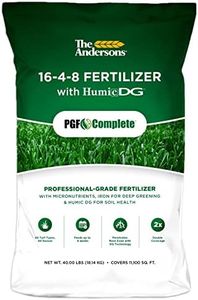
The Andersons Professional PGF Complete 16-4-8 Fertilizer with Humic (40lb)

Rating
9.4
Release Rate
Soil pH Compatibility

Most important from
2340 reviews

Release Rate
Its slow-release formula feeds the lawn steadily for weeks, reducing the need for frequent applications.
Soil pH Compatibility
Users report no brown or burning patches, even with vigorous growth and regular mowing.

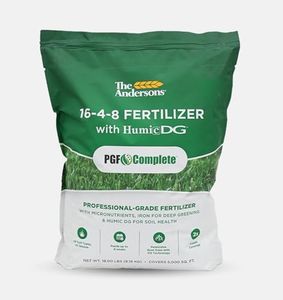
The Andersons Professional PGF Complete 16-4-8 Fertilizer is designed for lawn grasses and offers a well-balanced nutrient mix with a 16-4-8 NPK ratio, providing a strong dose of nitrogen for green growth, moderate phosphorus for roots, and potassium for overall lawn health. Its super-fine granules ensure even spreading, helping to cover your lawn consistently. This fertilizer combines quick-release nitrogen to feed your grass immediately, along with slow-release nitrogen that continues feeding your lawn for up to 8 weeks, reducing the need for frequent applications. It also includes iron, micronutrients, and humic acid, which support lawn vigor and soil health. While itโ€™s a granular fertilizer suited for seasonal lawn care, it is not sold in California due to regulatory reasons.

The product works well across various soil types but is best suited for typical lawn soils rather than highly acidic or alkaline conditions. Its 40-pound size covers a good area, making it a solid choice for homeowners seeking a long-lasting, effective fertilizer. A minor drawback is that it may be more than what very small lawns require, and since itโ€™s granular, proper spreading tools are recommended for best results. For those wanting a fertilizer that feeds their lawn steadily with added soil benefits, this product is a strong candidate.

Rating
9.4
Release Rate
Soil pH Compatibility

Most important from
2340 reviews

Release Rate
Its slow-release formula feeds the lawn steadily for weeks, reducing the need for frequent applications.
Soil pH Compatibility
Users report no brown or burning patches, even with vigorous growth and regular mowing.
#3

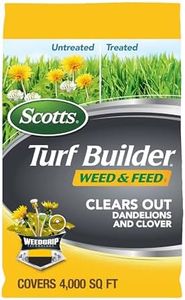
Scotts Turf Builder Weed & Feed5, 11.32 lbs.

Rating
9.4
NPK Ratio
Type of Fertilizer

Most important from
36406 reviews

NPK Ratio
Delivers a noticeable deep green color and vigorous growth, especially on Bermuda grass.
Type of Fertilizer
Combines weed control and lawn feeding effectively, improving the overall health and appearance of the grass.

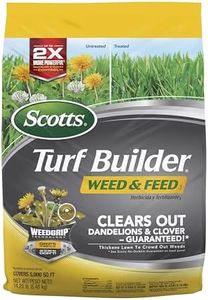
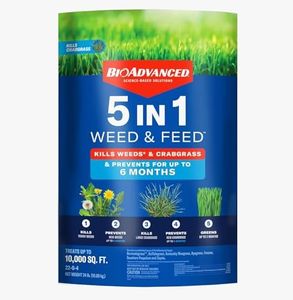
Scotts Turf Builder Weed and Feed5 combines fertilizer and weed control in one product, making it convenient for homeowners looking to both nourish their lawn and reduce common weeds like dandelions and clover. It feeds your grass to help it grow thicker and stronger, which naturally helps crowd out weeds over time.

This product is designed for use on popular grass types such as Bermudagrass, Bluegrass, Fescue, and Ryegrass, but should be avoided on certain types like St. Augustinegrass and Bentgrass. The granules apply easily with a spreader and cover up to 4,000 square feet, which is practical for medium-sized lawns. It works best when applied to a wet lawn during active weed growth and temperatures between 60ยฐF and 90ยฐF, but itโ€™s important not to use it more than twice a year to avoid overfeeding.

The fertilizerโ€™s slow-release feature helps provide steady feeding over time. This product is a reliable choice for homeowners wanting a combined solution for weed control and lawn feeding, especially for common turfgrass varieties, and is best used in warmer months when weeds are actively growing.

Rating
9.4
NPK Ratio
Type of Fertilizer

Most important from
36406 reviews

NPK Ratio
Delivers a noticeable deep green color and vigorous growth, especially on Bermuda grass.
Type of Fertilizer
Combines weed control and lawn feeding effectively, improving the overall health and appearance of the grass.

Buying Guide for the Best Grass Fertilizers

Choosing the right grass fertilizer is essential for maintaining a healthy and lush lawn. Fertilizers provide the necessary nutrients that grass needs to grow strong and green. When selecting a fertilizer, it's important to understand the different types and their specific benefits. This will help you make an informed decision based on your lawn's needs and conditions.
NPK RatioThe NPK ratio represents the percentage of nitrogen (N), phosphorus (P), and potassium (K) in the fertilizer. Nitrogen promotes leaf growth and vibrant green color, phosphorus supports root development, and potassium enhances overall health and disease resistance. For a lush lawn, a higher nitrogen content is often preferred. However, the right balance depends on your lawn's specific needs. For example, a new lawn may benefit from higher phosphorus to establish strong roots, while an established lawn may need more nitrogen for green growth.
Type of FertilizerFertilizers come in various forms, including granular, liquid, and organic. Granular fertilizers are easy to apply and provide a slow release of nutrients over time, making them ideal for long-term feeding. Liquid fertilizers offer quick nutrient absorption and are great for immediate results. Organic fertilizers are made from natural sources and improve soil health while providing nutrients. Choose the type based on your preference for application and the immediate needs of your lawn.
Release RateThe release rate of a fertilizer indicates how quickly the nutrients are made available to the grass. Slow-release fertilizers provide a steady supply of nutrients over an extended period, reducing the risk of over-fertilization and minimizing the need for frequent applications. Fast-release fertilizers deliver nutrients quickly, which can be beneficial for a quick green-up but may require more frequent applications. Consider your lawn care routine and how often you want to fertilize when choosing the release rate.
Seasonal FertilizerDifferent fertilizers are formulated for specific seasons. Spring fertilizers typically have higher nitrogen content to promote rapid growth and green-up after winter. Summer fertilizers focus on maintaining health and resilience during hot weather, often with balanced NPK ratios. Fall fertilizers are designed to strengthen roots and prepare the lawn for winter, usually with higher potassium content. Select a fertilizer based on the current season and the specific needs of your lawn during that time.
Soil pH CompatibilitySoil pH affects nutrient availability and grass health. Most grasses prefer a slightly acidic to neutral pH (6.0-7.0). Some fertilizers are formulated to adjust soil pH, either raising or lowering it to optimal levels. Testing your soil pH before choosing a fertilizer can help ensure that you select one that complements your soil conditions, promoting better nutrient uptake and overall lawn health.

FAQ