We Use CookiesWe use cookies to enhance the security, performance, functionality and for analytical and promotional activities. By continuing to browse this site you are agreeing to our privacy policy

10 Best Wood Moisture Meters 2026 in the United States
How do we rank products for you?

Our technology thoroughly searches through the online shopping world, reviewing hundreds of sites. We then process and analyze this information, updating in real-time to bring you the latest top-rated products. This way, you always get the best and most current options available.

headphones-stars

Our Top Picks

#1

Winner

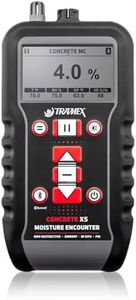
Tramex Concrete Moisture Encounter CMEX5 | Meter for Measuring Moisture Content & Relative Humidity in Concrete, Wood & Building Materials

Rating
10.0
Chosen by1,271
Accuracy
Type of Meter
Measurement Range

Most important from
21 reviews

Accuracy
Provides extremely accurate moisture readings essential for assessing water damage on various materials including wood and concrete.
Type of Meter
Offers non-destructive testing that delivers instant moisture content results without damaging surfaces, ideal for expensive flooring.
Measurement Range
Versatile enough to measure moisture levels in wood, drywall, tile, and concrete, eliminating the need for multiple devices.
Display and Readability
Features a clear, user-friendly interface with large, easy-to-read numbers and intuitive controls suitable for both professionals and homeowners.
Additional Features
Built with durable, professional-grade construction that withstands regular use and delivers long-term reliability.

The Tramex Concrete Moisture Encounter CMEX5 is a versatile moisture meter designed for measuring moisture in wood, concrete, and other building materials. It uses non-destructive methods to quickly provide moisture content readings, making it ideal for anyone needing fast and reliable checks without damaging surfaces. This meter offers both pin and pinless testing options, along with a built-in hygrometer that measures humidity, temperature, and dew point, providing a comprehensive view of moisture conditions around your project.

Its measurement depth extends up to 3/4 inch for slab testing and can reach 100 mm with an optional probe, allowing for accurate readings inside concrete. The device delivers solid accuracy based on industry-standard gravimetric testing and supports specific material scales like anhydrite and gypsum, which is helpful in construction-related tasks. Additionally, it connects via Bluetooth to an app for creating moisture maps and reports, which is valuable for professionals who need to document their findings.

Some users may find the meter more specialized and pricier compared to basic wood moisture meters, and optional probes are required to unlock its full potential in concrete. The display is clear and user-friendly, but proper calibration and understanding of its functions are essential to achieve the best results. This meter is a strong choice for contractors, builders, and serious DIYers working with wood and concrete who want a comprehensive moisture testing tool with advanced digital features.

Rating
10.0
Chosen by1,271
Accuracy
Type of Meter
Measurement Range

Most important from
21 reviews

Accuracy
Provides extremely accurate moisture readings essential for assessing water damage on various materials including wood and concrete.
Type of Meter
Offers non-destructive testing that delivers instant moisture content results without damaging surfaces, ideal for expensive flooring.
Measurement Range
Versatile enough to measure moisture levels in wood, drywall, tile, and concrete, eliminating the need for multiple devices.
Display and Readability
Features a clear, user-friendly interface with large, easy-to-read numbers and intuitive controls suitable for both professionals and homeowners.
Additional Features
Built with durable, professional-grade construction that withstands regular use and delivers long-term reliability.
#2

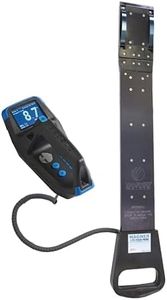
Wagner Meters Industrial Hand-held Wood Moisture Meters (L5300 + 40-inch L722 Lumber Stack Probe Combo (Standard Calibration))

The Wagner Meters L5300 combined with the 40-inch L722 Lumber Stack Probe is a robust tool designed specifically for industrial use in sawmills and wood manufacturing. It offers a thorough moisture detection system that can measure moisture both on the surface of individual boards and deep inside large lumber stacks, thanks to the long probe. This is especially useful for professionals who need to track moisture throughout the drying process to avoid defects and improve product quality. The meter features a clear histogram display, making it easier to spot wet spots and uneven drying, which helps in making quick decisions.

It supports storing a large number of readings with organized groups, and data can be transferred via Bluetooth or USB for detailed analysis and reporting—a great advantage for quality control teams. The device is built tough to handle demanding environments, ensuring reliability on busy production floors. However, this advanced functionality may be more than what casual users or small-scale woodworkers require, and some might find the meter a bit complex compared to simpler models.

The product’s calibration is standard, though occasional recalibration might be necessary to maintain accuracy for critical measurements. Battery-powered operation makes it portable but requires attention to power levels during heavy use. This meter represents a solid choice for professionals needing deep, accurate moisture readings and detailed data management, while possibly exceeding the needs of basic moisture checks.

#3

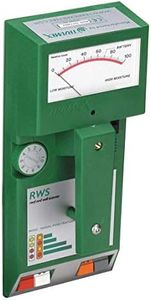
Tramex Roof & Wall Moisture Scanner RWS | Pinless Meter for Measuring Moisture Conditions in Walls & Roofing Systems

Rating
9.4
Type of Meter
Accuracy
Depth of Measurement

Most important from
13 reviews

Type of Meter
Effectively detects moisture through roofing materials, enabling targeted repairs that save on insulation and labor costs.
Accuracy
Lacks precision for wood moisture content and does not offer digital calibration or data logging features.
Depth of Measurement
Pinless design allows non-destructive moisture measurement up to several inches deep, ideal for roof and wall inspections.
Display and Readability
Analog dial display provides straightforward relative moisture readings without digital complexity.
Calibration
Lacks precision for wood moisture content and does not offer digital calibration or data logging features.
Additional Features
Handheld form with telescopic handle makes accessing difficult spots like rooftops more practical.

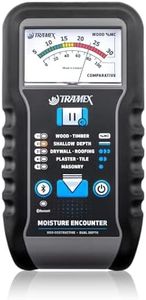
The Tramex Roof & Wall Moisture Scanner RWS is a pinless moisture meter designed primarily for checking moisture levels in roofing materials and various wall constructions, including insulation systems and EIFS. Its non-destructive approach enables moisture detection without damaging surfaces, which is beneficial for avoiding drilling or puncturing roofing or walls. It can measure moisture up to about 4 inches deep, providing insight not just on the surface but deeper inside layers.

This meter displays moisture levels on a relative scale from 0 to 100, using analog readings rather than a digital display. It offers multiple modes to adjust sensitivity and depth, assisting in locating the exact source of leaks or damp areas, making it particularly useful for roof inspections and building envelope evaluations. The handheld design with a telescopic handle enhances practicality for reaching higher or awkward spots such as rooftops.

While it is well-suited for roofing and wall materials, it may not deliver precise moisture readings specifically for wood, since it is not pin-type and does not provide direct percentage moisture content for wood. Additionally, it does not include advanced digital calibration or data logging features. For quick, non-invasive moisture checks on roofs or insulated walls, this meter is effective; however, for detailed wood moisture analysis or woodworking tasks, a pin-type meter or one with digital readout could be more appropriate.

Rating
9.4
Type of Meter
Accuracy
Depth of Measurement

Most important from
13 reviews

Type of Meter
Effectively detects moisture through roofing materials, enabling targeted repairs that save on insulation and labor costs.
Accuracy
Lacks precision for wood moisture content and does not offer digital calibration or data logging features.
Depth of Measurement
Pinless design allows non-destructive moisture measurement up to several inches deep, ideal for roof and wall inspections.
Display and Readability
Analog dial display provides straightforward relative moisture readings without digital complexity.
Calibration
Lacks precision for wood moisture content and does not offer digital calibration or data logging features.
Additional Features
Handheld form with telescopic handle makes accessing difficult spots like rooftops more practical.

Buying Guide for the Best Wood Moisture Meters

Choosing the right wood moisture meter is essential for anyone working with wood, whether you're a professional carpenter, a DIY enthusiast, or someone who needs to ensure the quality of firewood. A wood moisture meter helps you measure the moisture content in wood, which is crucial for preventing issues like warping, cracking, or mold growth. To make an informed decision, you need to understand the key specifications and how they relate to your specific needs.
Type of MeterThere are two main types of wood moisture meters: pin-type and pinless. Pin-type meters use two metal probes that you insert into the wood to measure moisture content. They are generally more accurate but can leave small holes in the wood. Pinless meters use electromagnetic sensors to measure moisture without damaging the wood. They are faster and easier to use but may be less accurate on very dense or very thin wood. Choose a pin-type meter if accuracy is your top priority and you don't mind minor damage to the wood. Opt for a pinless meter if you need quick, non-destructive measurements.
Measurement RangeThe measurement range indicates the range of moisture content that the meter can detect, usually expressed as a percentage. This is important because different types of wood and different applications require different moisture levels. For example, woodworking projects typically require wood with a moisture content of 6-8%, while firewood should have a moisture content below 20%. Look for a meter with a range that covers the moisture levels relevant to your needs. A typical range might be 5-30%, but some meters offer wider ranges.
AccuracyAccuracy refers to how close the meter's readings are to the actual moisture content. This is crucial for ensuring the quality and durability of your wood projects. Accuracy is usually expressed as a percentage, such as ±1%. Higher accuracy is better, but it often comes at a higher cost. If you are working on high-precision projects like fine woodworking or flooring, opt for a meter with high accuracy. For less critical applications like firewood, a meter with moderate accuracy may suffice.
Depth of MeasurementDepth of measurement indicates how deep into the wood the meter can measure moisture content. This is important because moisture levels can vary at different depths. Pin-type meters usually measure at the depth of the pins, while pinless meters can measure at various depths depending on the model. If you need to measure moisture deep within thick pieces of wood, look for a meter with a greater depth of measurement. For surface-level measurements, a shallower depth will be sufficient.
Display and ReadabilityThe display and readability of the meter are important for ease of use. Look for a meter with a clear, easy-to-read display, preferably with a backlight for use in low-light conditions. Some meters also offer digital displays with additional features like hold functions, which allow you to freeze the reading on the screen. If you often work in dimly lit areas or need to take multiple readings quickly, prioritize a meter with a high-quality display.
CalibrationCalibration ensures that the meter provides accurate readings over time. Some meters come with automatic calibration, while others require manual calibration using a reference material. Automatic calibration is more convenient and ensures consistent accuracy, but it may add to the cost. If you need a meter for professional use or high-precision projects, choose one with automatic calibration. For occasional use, manual calibration may be sufficient.
Additional FeaturesAdditional features can enhance the functionality and convenience of a wood moisture meter. These may include temperature compensation, which adjusts readings based on the ambient temperature, or data logging, which allows you to store and review past readings. Consider what additional features might be useful for your specific needs. For example, if you work in varying temperatures, temperature compensation can improve accuracy. If you need to track moisture levels over time, data logging can be very helpful.

FAQ